


Buying a home is a major financial decision, and knowing what happens at each stage can make the process feel much easier. If you are learning how to buy a house in Stamford, CT, you will need to prepare your finances, find a suitable property, make an offer, complete inspections, secure mortgage approval, and close the purchase. Working with a trusted Commercial Real Estate Agency in Stamford, CT, can also help you explore local property options and better understand the Stamford real estate market.
Many buyers assume the hardest part is saving for a down payment or finding the right house. Those steps matter, but the process also involves deadlines, paperwork, property checks, and decisions that can affect your budget.
Stamford offers different housing options, from condos and townhomes to single-family houses. Each type of property can come with different costs, maintenance needs, and rules. Understanding these differences before making an offer can help you choose a home that fits your needs.
This guide explains the main steps to buy a house in Stamford, what to expect during the home purchase timeline, and how to prepare for a smoother transaction.
1. Review Your Budget Before You Start Looking
Before browsing listings, work out how much you can comfortably spend on a home. The amount a lender may approve is not always the amount that makes sense for your daily life.
Start by reviewing your income, savings, monthly debts, credit history, and regular household expenses. Decide how much you can put toward the down payment without using all your available cash.
Remember to budget for expenses beyond the purchase price, including:
- Mortgage closing costs and lender fees
- Property taxes
- Homeowners insurance
- Home inspection and appraisal fees
- Moving costs and utility setup
- Repairs, maintenance, and emergency savings
Property taxes deserve special attention when buying in Stamford. Your total monthly housing cost will depend partly on the property's assessed value and the applicable local tax rate.
If you are considering a condo, check the monthly association fee and ask about any special assessments. For a single-family home, review the property's condition and likely maintenance needs.
A realistic budget gives you a clear price range and helps you avoid falling in love with a home that costs more than you can comfortably afford.
2. Get Mortgage Pre-Approved
Mortgage pre-approval is one of the first practical steps in the homebuying process. A lender reviews information about your finances and estimates how much you may be able to borrow.
You may need to provide pay stubs, tax returns, bank statements, identification, and details about your debts and employment. The lender may also review your credit history.
Pre-approval can help you understand your likely loan amount, down payment needs, and estimated monthly payment. It can also show sellers that you have started the financing process.
However, pre-approval is not a final mortgage approval. The lender will still need to verify your finances, review the property, and complete the required underwriting steps.
Compare offers from more than one lender when possible. Look beyond the interest rate and ask about lender fees, mortgage insurance, loan terms, and the estimated cash needed at closing.
Avoid taking on major new debt or making large financial changes during the mortgage process without speaking to your lender first.
3. Find a Home That Fits Your Needs
Once you have a budget and a clearer idea of your financing options, you can begin looking at homes in Stamford.
Make a list of your main needs. Think about the number of bedrooms, commute, parking, outdoor space, access to public transportation, and distance from schools or other places you visit regularly.
It can help to separate your must-haves from features you would simply like to have. This makes it easier to compare properties without losing sight of your budget.
As you review listings, look at more than the asking price. Consider the property's age, condition, heating system, roof, estimated property taxes, and potential repair costs.
You should also research the surrounding area and visit the property at different times when practical. Traffic, noise, parking, and travel times may affect your experience of living there.
A property that looks affordable online may cost more to own than expected. Comparing the full cost of different homes can help you make a better decision. If you already own a property and plan to sell before moving, explore how selling your home requires expert strategy to help you prepare for your next purchase.
4. Make an Offer on the Property

When you find a suitable home, the next step is deciding what to offer and which terms to include.
Your offer should reflect your budget, the property's condition, comparable sales, and current market conditions. The asking price alone does not tell you what a property is worth or how much competition you may face.
Your real estate agent can help you review relevant local sales and understand the terms commonly used in purchase offers. The offer may cover the purchase price, proposed closing date, deposit, financing terms, inspection provisions, and other conditions.
Read every term before signing. Contingencies can provide protection if certain conditions are not met, but their scope and deadlines depend on the contract.
If the seller receives several offers, they may accept one, reject them, or ask buyers to submit revised terms. A higher offer is not always the only factor. The seller may also consider financing, timing, and the conditions attached to each offer.
Do not offer more than you can afford just because you want to secure a particular home. Your budget should guide the decision.
5. Understand the Home Inspection Process
After your offer is accepted, you will typically move into the inspection and due diligence stage. The exact timing depends on the contract, so pay close attention to the dates.
The home inspection process gives you a closer look at the property's visible condition. A qualified inspector may examine the roof, foundation, plumbing, electrical systems, heating, cooling, windows, and other accessible components.
The inspector will usually provide a written report describing observed issues. Some findings may be routine maintenance concerns, while others may require further review or costly repairs.
For example, an older roof may need replacement sooner than expected. Signs of moisture may call for additional evaluation. A heating system near the end of its useful life could affect your future budget.
An inspection is not a guarantee that every defect will be found. It also does not replace specialized checks when a specific concern requires further testing.
Depending on the property, you may want to discuss radon testing, pest inspections, or other evaluations with your inspector and real estate professional.
Once you receive the report, review the findings carefully. Your options may depend on the contract and applicable deadlines. You might negotiate repairs, request a credit, accept the property as it is, or use a contractual right to withdraw if available.
Do not ignore major issues just to keep the purchase moving. Understand the likely cost and risk before deciding how to proceed.
6. Complete the Appraisal and Mortgage Approval
The inspection and appraisal serve different purposes. An inspection looks at the property's condition, while an appraisal estimates its market value for the lender.
The lender generally orders an appraisal as part of the mortgage process. If the appraised value is lower than the agreed purchase price, the lender may base its loan calculation on the lower value, depending on the loan program.
This can create a gap between the loan amount and the price you agreed to pay. You may need to discuss options with your lender and real estate agent, review the contract, or renegotiate with the seller.
During this stage, the lender will also continue reviewing your financial documents. You may be asked for updated bank statements, explanations of deposits, or other information.
Respond to these requests promptly. Missing documents can delay approval and affect your closing date.
Before closing, avoid opening new credit accounts, financing a vehicle, or making unexplained large deposits without checking with your lender. These changes can affect your loan review.
7. Prepare for Closing Costs and Final Paperwork
As your purchase moves forward, you will receive more information about the money due at closing.
Closing costs may include lender charges, appraisal fees, title services, title insurance, legal services, recording fees, prepaid interest, homeowners insurance, and initial escrow deposits. The exact amounts depend on the property, lender, loan, and transaction terms.
In Connecticut, real estate conveyance taxes apply to property transfers. Who pays each applicable charge depends on state rules and the transaction. Ask your closing attorney to explain which costs are your responsibility rather than assuming every tax or fee belongs to the buyer.
Your lender will generally provide a Closing Disclosure before closing. Review it alongside your earlier Loan Estimate and ask about any amount you do not understand.
You should also confirm the final amount you need to bring to closing and how the funds must be sent. Follow your closing professional's verified instructions. Real estate wire fraud is a known risk, so independently confirm wire details by calling a trusted phone number before transferring money.
Prepare your identification and any other documents requested by the closing team. Taking time to check the paperwork can help prevent avoidable delays. If you are still exploring local properties, discover the best of Stamford living, each area bringing its own character and lifestyle to help you understand the local real estate market.
8. Complete the Final Walk-Through and Close
A final walk-through usually takes place shortly before closing. It gives you a chance to check the home's condition and confirm that agreed-upon repairs or other contract requirements have been addressed.
Check that the property is in the expected condition, that included appliances or fixtures remain, and that there are no obvious new problems. If you find an issue, contact your real estate agent before signing the final paperwork.
At closing, you will sign the documents needed to complete the purchase and mortgage. You will also pay the required funds and follow the closing team's instructions for transferring ownership.
Once the transaction is completed and the required conditions are met, you can receive the keys according to the closing arrangements.
After moving in, keep copies of your closing documents, mortgage information, inspection report, insurance policy, and property records. Set reminders for mortgage payments, property taxes, insurance renewals, and routine maintenance.
How Long Does the Home Purchase Timeline Take?
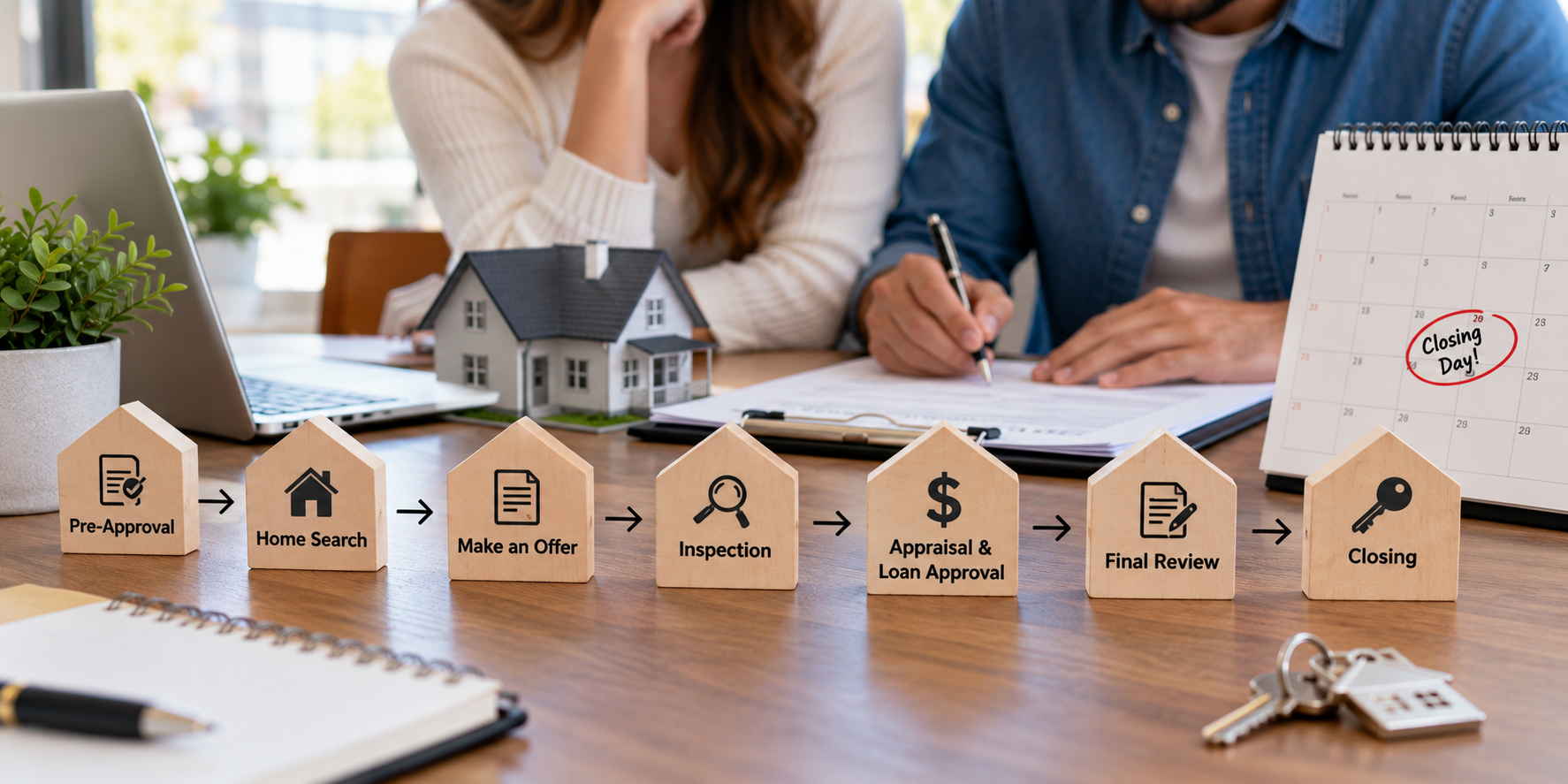
The home purchase timeline varies based on financing, property conditions, contract terms, and how quickly everyone completes their tasks.
A financed home purchase often takes around 30 to 60 days from an accepted offer to closing, although some transactions take less or more time. Finding the right home may add weeks or months before that stage begins.
Here is a general timeline:
Stage | Typical Timing |
Budget planning and pre-approval | Days to several weeks |
Home search | A few weeks to several months |
Offer and negotiations | A few days to several weeks |
Inspection and due diligence | Often within the first 1–2 weeks after acceptance, depending on the contract |
Appraisal and mortgage underwriting | Several weeks |
Final review and closing | Often during the last week before closing |
These are planning estimates, not fixed deadlines. Contract dates and lender requirements take priority.
You can reduce avoidable delays by getting documents ready early, booking inspections promptly, responding to lender requests, and reviewing closing figures as soon as they arrive.
Common Mistakes to Avoid When Buying a Home
Even buyers who have saved carefully can run into problems if they overlook key parts of the process.
Focusing only on the down payment. Closing costs, property taxes, insurance, and repairs also affect affordability.
Skipping important contract details. Inspection, financing, and other contingencies have specific terms and deadlines. Read them carefully before signing.
Making major financial changes. New debt or large unexplained deposits may complicate mortgage approval.
Ignoring the inspection report. Understand the likely cost of significant repairs before deciding whether to proceed.
Waiting until the last minute to review closing documents. Read your figures early and ask questions before closing day.
Underestimating the cost of ownership. Keep savings available for maintenance and unexpected expenses after you move in.
Final Thoughts on Buying a House in Stamford, CT
Learning how to buy a house in Stamford, CT, starts with a realistic budget and a clear understanding of each step. From mortgage pre-approval and property searches to inspections, appraisal, and closing, every stage helps you make an informed decision.
Give yourself enough time to review the home's condition, understand the contract, and confirm the full cost of ownership. Ask questions when something is unclear, and keep track of every deadline.
If you are preparing to purchase a home in Stamford, you can explore the homebuying resources from Vantage Point Properties to learn more about the process and plan your next steps.
Check out this article next

